-
Shop
- Advanced Technologies
- AI Career Advantage Collection
- AI Skills Mastery 2026 Collection
- Best-Sellers
- Car Accessories
- Dating & Social Skills
- Digital Resources
- AI & Technology
- Beauty
- Budgeting & Saving
- Emotional Intelligence
- Entrepreneurship & Business Growth
- Financial Independence
- Financial Mindset & Psychology
- Goal Setting
- Home Styling & Organization
- Kitchen & Recipes
- Leadership
- Mindfulness
- Mindset
- Motivation
- Online Business
- Parenting & Child Development
- Personal Style & Fashion
- Pet Lifestyle & Wellness
- Positive Thinking
- Productivity
- Self Confidence
- Sleep Improvement
- Stress Management & Relaxation
- Wellness
- Yoga & Mind-Body Practices
- Education & Learning
- Family & Parenting
- Fashion
- Furniture
- Gadgets
- Health & Beauty
- Health & Wellness
- Home & Garden
- Kids & Babies
- Lighting
- Luxury Brands Collection
- Patio, Lawn & Garden
- Personal Growth
- Pet Care
- Pet Supplies
- Pets
- Sport & Outdoors
- Travel
- Wealth
Fast Reset Checklist to Stop Negative Thinking Spirals
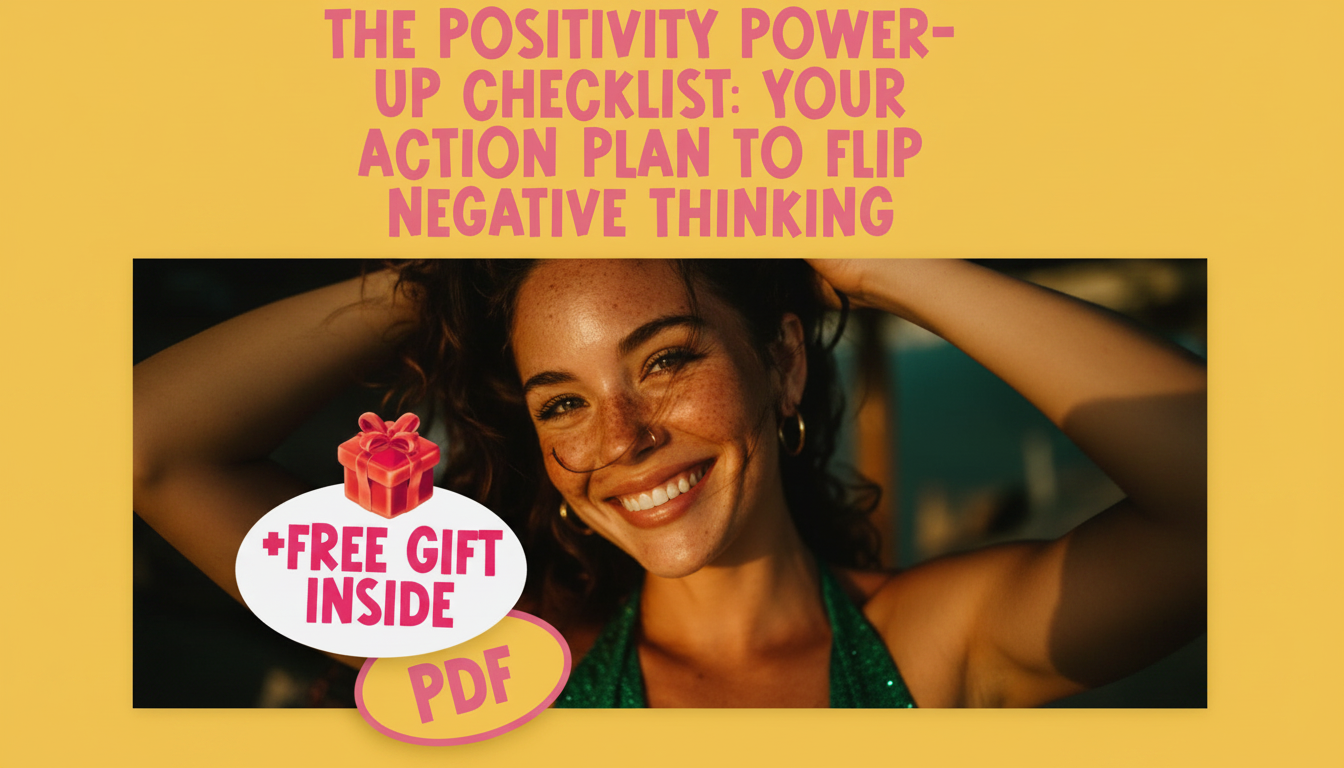
Negative Thinking Doesn’t Need a Big Fix—It Needs a Fast Reset
Negative thoughts can feel automatic—especially under stress, tight deadlines, or when confidence is low. The problem usually isn’t a lack of “positive vibes.” It’s that the mind defaults to familiar loops (worst-case predictions, harsh self-talk, comparison) faster than you can reason with them.
A short, repeatable checklist creates a reliable pause point. It helps interrupt the spiral, calm your body enough to think clearly, reframe what’s happening without denying reality, and choose one next step that supports a more positive attitude. The Positivity Power-Up Checklist digital download is designed to fit into real life—minutes at a time, daily or as-needed—so progress stays practical and measurable.
What this checklist is (and what it isn’t)
This is a structured, self-guided tool for day-to-day mindset maintenance. It’s especially helpful when thoughts feel loud, urgent, or repetitive.
- What it is: A practical set of prompts to spot negative thought patterns, calm the nervous system, and shift perspective without pretending everything is fine.
- Designed for speed: In a few minutes, you can identify the thought, name the trigger, and choose a better response.
- What it isn’t: A replacement for therapy, medical care, or crisis support. If you’re in danger or feel unable to stay safe, seek immediate professional help.
- Works best with small behavior support: Sleep, movement, boundaries, hydration, and social connection make the “reframe” easier to access.
Many of the prompts align with cognitive behavioral therapy (CBT) principles—particularly the idea that naming and challenging unhelpful thoughts can reduce distress over time. For background, see the American Psychological Association overview of CBT and the NHS guide to CBT.
Why a checklist can flip a negative attitude faster than “just think positive”
When emotions spike, your brain is juggling threat signals, stress hormones, and a rush to “solve” discomfort. That’s not the best moment to freestyle your way into a better mindset. A checklist helps because it supplies a sequence when you have the least bandwidth to create one.
- Reduces decision fatigue: You don’t have to figure out what to do next; you just follow the steps.
- Creates distance from the thought: Labeling “I’m failing” as a thought (not a fact) makes it easier to evaluate.
- Uses quick grounding to lower intensity: A 60-second reset can reduce the emotional volume so you can think more clearly.
- Retrains attention toward progress: Tracking tiny wins builds evidence that you’re moving forward.
Common negative loops and the checklist-style counter move
| Negative loop | What it feels like | Checklist counter move |
|---|---|---|
| Catastrophizing | One setback means everything will collapse | Write the feared outcome, then list 2 more likely outcomes and 1 controllable next step |
| Mind reading | Assuming others are judging or disappointed | Ask: “What evidence do I have?” + draft a neutral clarification message |
| All-or-nothing | If it’s not perfect, it’s pointless | Define the “minimum viable win” for today (10% improvement) |
| Personalizing | Blaming yourself for things outside your control | Separate: what’s mine to influence vs. what’s not |
How to use the Positivity Power-Up Checklist (a quick, repeatable flow)
The goal is not to force optimism. The goal is to move from reactive to responsive—so your next choice supports stability.
For anxious spirals, pairing grounding + reframing can be especially helpful. The National Institute of Mental Health overview of anxiety disorders is a solid reference if you’re sorting out what you’re experiencing and what support options exist.
A 7-day “power-up” plan to build momentum
Weekly mini-tracker (copy/paste into notes or print)
| Day | Trigger | Thought loop | Reframe | Next action | Win (1 sentence) |
|---|---|---|---|---|---|
| Mon | |||||
| Tue | |||||
| Wed | |||||
| Thu | |||||
| Fri | |||||
| Sat | |||||
| Sun |
Who this digital download fits best
If your negative loop is tied to work stress or uncertainty, pairing mindset structure with practical planning can help. For example, Low-Stress Online Business Idea Pack is built for simplifying next steps—so your “action” step becomes clearer when motivation is shaky.
Make it stick: simple ways to use it daily
Some people like adding a small, tangible “reset cue” to anchor the habit—like putting on a ring before starting the checklist. If that helps you, the Minimalist Pearl Resin Ring – Waterproof 18K Gold-Plated Stainless Steel can be a simple everyday reminder to pause and choose your next step.
FAQ
How long does it take to complete the checklist?
Most people finish it in about 3–10 minutes. On high-stress days, using just the first steps (pause, label, and a 60-second grounding reset) can still interrupt the spiral and prevent an impulsive reaction.
Can this help with anxiety-driven negative thoughts?
It can support anxiety-driven spirals by combining grounding with a realistic reframe and a small next action. It isn’t a medical treatment, so if anxiety feels severe, persistent, or interferes with daily functioning, professional support is an important next step.
Should it be printed or used on a phone?
Printing helps with visibility and makes it easy to grab during a busy moment, while using it on a phone is more portable and discreet. Many people do both: keep a printed copy at a desk and save a digital version in a notes app (or use a tablet stylus for quick check-ins).
Recommended for you


Was this article helpful?
Yes
No









Leave a comment